The Last Salt Caravans of the Afar
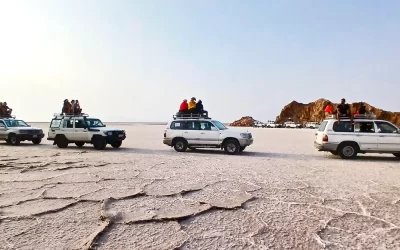
Long before Dallol or Erta Ale drew travelers to the Danakil, the salt flats of Lake Karum were already a working trade route. They still are. Most mornings, you can watch Afar men cut slabs of salt — locally called amole — directly from the flat white crust, shape them into standard blocks, and load them onto waiting camel and donkey trains bound for the highland markets.
It’s easy to treat this as a photo opportunity and move on. Our guides ask groups to slow down here, because what’s happening on the flats isn’t staged for visitors — it’s the same trade that’s supplied salt to Ethiopian highland communities for generations, run by people who grew up doing it.
How the cutting works
The salt crust on Lake Karum is thick enough in places to walk and work on, formed as ancient seawater trapped in the depression evaporated over thousands of years. Miners use hand tools to score and break the crust into uniform blocks — a skill that looks simple and isn’t; an inexperienced cut wastes salt and the miner’s own effort.
Once cut, blocks are stacked onto camels or donkeys in balanced loads, and the caravan sets out on a multi-day walk to Mekele or other highland trading points, where the salt is sold on to markets across the region.
“This isn’t a demonstration. If we’re there at the right hour, we’re watching someone’s actual workday.”
Meeting the Afar
The Afar are pastoralists first, and salt mining is one part of a livelihood built around this harsh landscape. Our guides, several of whom have longstanding relationships with families working the flats, can introduce visitors respectfully — this usually means brief, genuine exchanges rather than posed photos, and always on the miners’ terms.
We ask before photographing anyone at work on the flats, and we’d ask the same of you. A short conversation through your guide goes a lot further than a camera raised without one.
Fitting it into a route
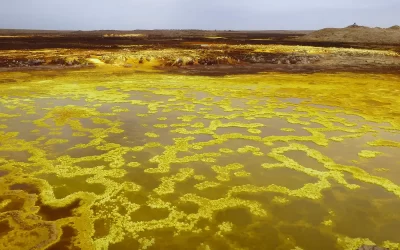
The salt flats sit close to Dallol, and most of our Danakil itineraries visit both in the same stretch — early morning at the flats to catch the caravans loading, then on to the mineral fields as the light shifts. If tradition and culture are as much a draw for you as the geology, tell your guide, and we’ll weight the itinerary toward more time on the flats.