Danakil Depression: The hottest place on Earth. Experience it.
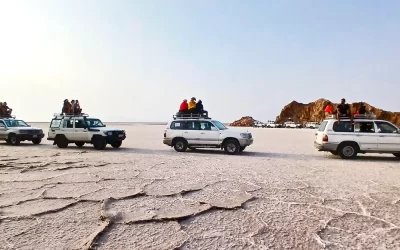
Authentic, locally-run expeditions through the Danakil Depression — active lava lakes, neon acid springs, ancient camel salt caravans, and the Afar people who call this extraordinary world home. Departures from Mekele and Semera.
Six sights found nowhere else on Earth
The Danakil Depression is a 200 × 50 km tectonic rift where Africa is literally splitting apart. These are its headline phenomena.
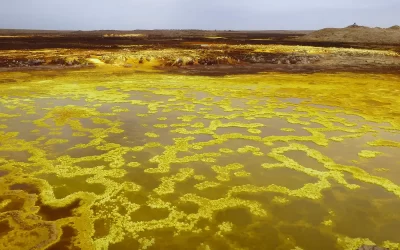
Dallol: Hydrothermal Field · 112°C
Neon yellow, vivid green, and rust-red acid pools that bubble at 112°C. Salt towers grow overnight. Sulfur chimneys hiss at the edge of the plain. Astrobiologists study Dallol as an analog for early Mars. Nothing looks like this anywhere else on Earth — or any other planet we know.
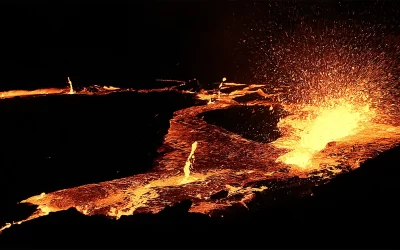
Erta Ale: Active Volcano · Permanent Lava Lake
A 613m basaltic shield volcano with one of the world’s only five permanent active lava lakes. Continuously active since at least 1906. The trek to the summit crater takes two hours at dusk, guided by torchlight. You sleep at the rim. The lava moves all night.
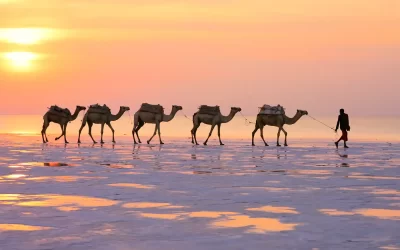
Lake Karum (Asale): Salt Flat · Ancient Trade Route
A vast fossil salt plain where Afar miners still cut salt blocks by hand and load them onto camel caravans bound for the Ethiopian highlands — a supply chain that has been operating continuously for over 2,000 years. Walk the blinding white crust. Float in the dense brine.
Gaet’ale Pond: Saltiest Water on Earth · 43% Salinity
Created in January 2005 when an earthquake reactivated a hot spring near Ahmed’ela village. At 43% salinity, this small yellow pool is the saltiest body of water on the planet — saltier than the Dead Sea. A geological event visible from the surface.
Saline Lake · 102m Below Sea Level Lake Afrera (Afdera)
A warm, shallow hypersaline lake ringed by palm trees and salt flats. Flamingos feed at the edges. The mineral-rich water holds you on the surface without effort. Float, swim, watch the sunset turn the salt flats orange. One of the Danakil’s most unexpected and serene experiences.
Afar Salt Miners & Camel Caravan, Living Culture · Afar People
The Afar people have mined salt in the Depression for millennia. Watch workers cut blocks from the crust by hand in the early morning, then load them onto camel caravans. This is not a recreation — it is one of the longest continuously operating trade routes on Earth, still active today.
Why the Danakil looks like another planet
The Danakil Depression is the place where Africa and Arabia are actively pulling apart at 8–18mm per year. The result is the most geologically active landscape on dry land.
A future ocean in formation
Why Dallol is neon-coloured
Rising magmatic fluids dissolve the thick salt evaporite deposits, ascend to the surface, and react with minerals to create the extraordinary palette: neon yellow from potash salts, vivid green from chloride formations, rust-red from iron oxides, white from fresh halite. Astrobiologists study Dallol as an analog for early Mars and Jupiter’s moon Europa.
Why the salt is so deep
The Red Sea has flooded the Danakil basin at least four times during the Pleistocene epoch. The last flood, approximately 130,000 years ago, left behind fossil coral reefs and over 500 metres of evaporite deposits — mainly halite. The salt you walk on at Lake Asale is a 130,000-year-old geological record of ancient seawater.
IUGS Geological Heritage Site (2022)
In October 2022, the International Union of Geological Sciences named the Danakil Rift Depression one of the world’s 100 geological heritage sites — the geological equivalent of UNESCO World Heritage status. The designation recognizes it as demonstrating “the ongoing birth of an ocean witnessed through tectonics and volcanism in an extreme evaporite arid environment.”
When to visit Danakil Depression
| Season | Months | Temp | |
|---|---|---|---|
| Cool & Dry | Nov – Feb | 30–34°C | ✅ |
| Shoulder | Oct / Mar | 35–38°C | ✅ |
| Hot & Dry | Apr – May | 38–45°C | ⚠️ |
| Rainy Season | Jun – Sep | 50°C+ | 🚫 |
Ready to read more?
Our complete 2026 Danakil Depression Travel Guide covers geology, safety, packing, costs, and photography — all in one article.
Read the full Guide